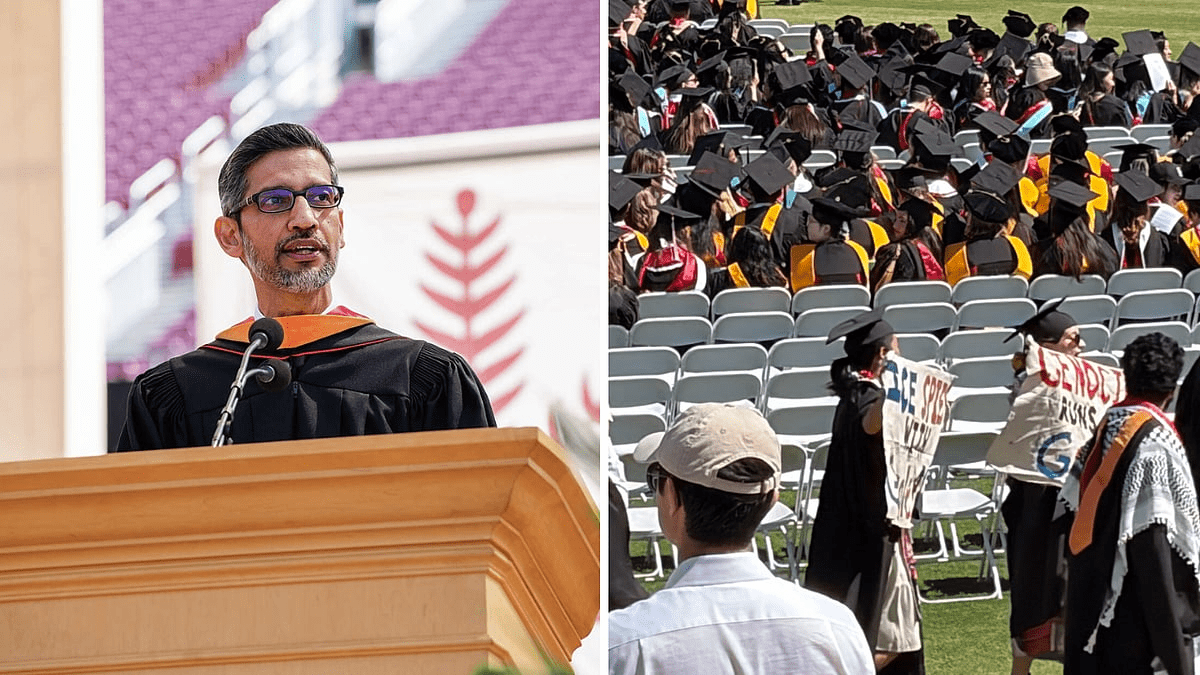
Activists from No Tech for Apartheid blast the tech giant’s $1.2 billion “Project Nimbus” defense contract, while the Alphabet chief entirely sidesteps artificial intelligence to champion a message of “California Optimism.”
The traditional celebratory atmosphere anchoring one of elite academia’s most prominent annual gatherings was broken by a wave of organized student resistance. Delivering the keynote address at Stanford University’s 135th Commencement ceremony on Sunday, June 14, 2026, the tech executive faced a highly publicized Sundar Pichai Stanford graduation walkout. More than 100 graduating students silently vacated their seats inside the packed Stanford Stadium just as the tech chief took the podium.
The demonstration brought a sharp dose of geopolitical friction to an audience of over 20,000 attendees, including roughly 3,600 graduating students.
Organized weeks in advance by campus activist groups, the walkout specifically targeted Google’s corporate relationships with sovereign defense forces.
As a notable chunk of the student body marched out of the arena holding Palestinian flags and chanting “Free, Free Palestine,” Pichai continued his pre-written address, appearing unfazed by the commotion filtering through the stands.
Also Read | Imran Khan and Bushra Bibi Sentenced to 17 Years in Jail
The Corporate Battleground: Unpacking the Project Nimbus Backlash
Unlike other campus demonstrations across the United States this graduation season, the friction at Stanford did not center on anxiety regarding artificial intelligence automation or tech-driven job losses.
Instead, the students targeted a controversial, multi-year cloud infrastructure partnership known as Project Nimbus.
Signed in April 2021 for an initial seven-year term, the $1.2 billion contract binds Google and Amazon Web Services to provide advanced cloud computing data segments, machine learning frameworks, and artificial intelligence capabilities to the Israeli government and its defense facilities.
Student organizers from Stanford Students for Justice in Palestine (SJP) and No Tech for Apartheid issued a fierce public statement, declaring that they refused to let a tech billionaire lecture them on building wealth via military surveillance tools and corporate war profiteering.
The Pivot Plan: Why Google’s Leader Skipped the Tech Talk
The tension surrounding the event was magnified by how Pichai structured his commencement message.
While graduation speakers at global engineering institutions traditionally lean heavily into the futuristic impacts of generative models, the Alphabet CEO chose to sidestep detailed discussions of machine learning entirely.
| Monitored Keynote Attribute | Standard Tech-Executive Tropes | Pichai’s Revised 2026 Stanford Framework | Core Communication Objective Achieved |
| Primary Theme Axis | The inevitable rise of automated AI intelligence. | The Cultivation of “California Optimism.” | Avoided generating extra friction or draws for student boos. |
| Opening Hook Delivery | Standard praise of engineering achievements. | Self-deprecating jokes tracking his own “A-I” surname. | Lightened a tense stadium atmosphere early on. |
| Biographical Anchor | Stories documenting the founding of Google Chrome. | Memories of arriving from India to Sweet Hall in 1993. | Highlighted his personal, humble connection as a Stanford alum. |
| Core Career Advice | Instructions on staying ahead of automation. | “Filter the signal through the noise.” | Encouraged graduates to reframe hardships into positive outcomes. |
Note: Tech executives at recent university keynotes across the country have drawn direct, audible boos for over-promoting machine learning capabilities. Pichai’s total pivot away from industry terminology was viewed by analysts as a highly strategic move to keep his presentation human-centric.
The underlying text of the commencement address focused heavily on personal perspective and the psychological power of reframing your circumstances.
To explain his concept of “California Optimism,” Pichai shared a light memory from his initial arrival on campus as an international graduate student from Chennai in 1993. He recalled looking out his window and complaining out loud that the surrounding hills looked unappealingly brown.
His local host, an elderly woman named Mrs. Jane Earl, gently corrected him: “We prefer to call it golden,” she noted. This simple change in framing, Pichai explained, reshaped how he interacted with the entire West Coast tech ecosystem.
Also Read | Imran Khan and Bushra Bibi Sentenced to 17 Years in Jail
Five Distinct Sequences Defining the Stanford Commencement Clash
As the ceremony moved from formal academic processions into active political demonstration, security details tracked a highly calculated sequence of events:
The dramatic display highlights the deepening divide between major technology institutions and the highly active consumer base growing across elite university campuses.
By executing a peaceful, highly visible protest, the Stanford graduates made their ethical concerns central to the day’s narrative.
Meanwhile, by keeping his focus on personal resilience and historical perspectives, Pichai delivered his message to the remaining assembly, showing that even amidst intense public dissent, the next generation of builders must ultimately choose how they frame their circumstances to drive the world forward.
FAQ Section
What specifically triggered the Sundar Pichai Stanford graduation walkout today?
The walkout was a highly organized protest directed at Google’s involvement in Project Nimbus—a $1.2 billion joint cloud computing and AI infrastructure contract signed between Google, Amazon, and the Israeli government. Student activist groups argue that the technology contract directly assists corporate surveillance and military data logistics.
Did Sundar Pichai alter his speech to address the student protestors?
No. Sundar Pichai completely stuck to his pre-written text and chose not to directly address Project Nimbus or the protesting graduates during his keynote. He focused his remarks entirely on timeless, technology-agnostic life advice, using personal stories from his early years at Stanford to encourage graduates to embrace an attitude of optimism.
Why did the Google CEO choose to completely avoid talking about Artificial Intelligence?
While AI is the defining trend of modern Silicon Valley, talking about tech capabilities at recent university commencements has drawn heavy backlash and boos from graduating classes anxious about the tech job market. Pichai strategically avoided the topic, joking that the subject already sat in the last two letters of his last name anyway, choosing instead to focus on human-centric personal guidance.
Also Read | Imran Khan and Bushra Bibi Sentenced to 17 Years in Jail
End…