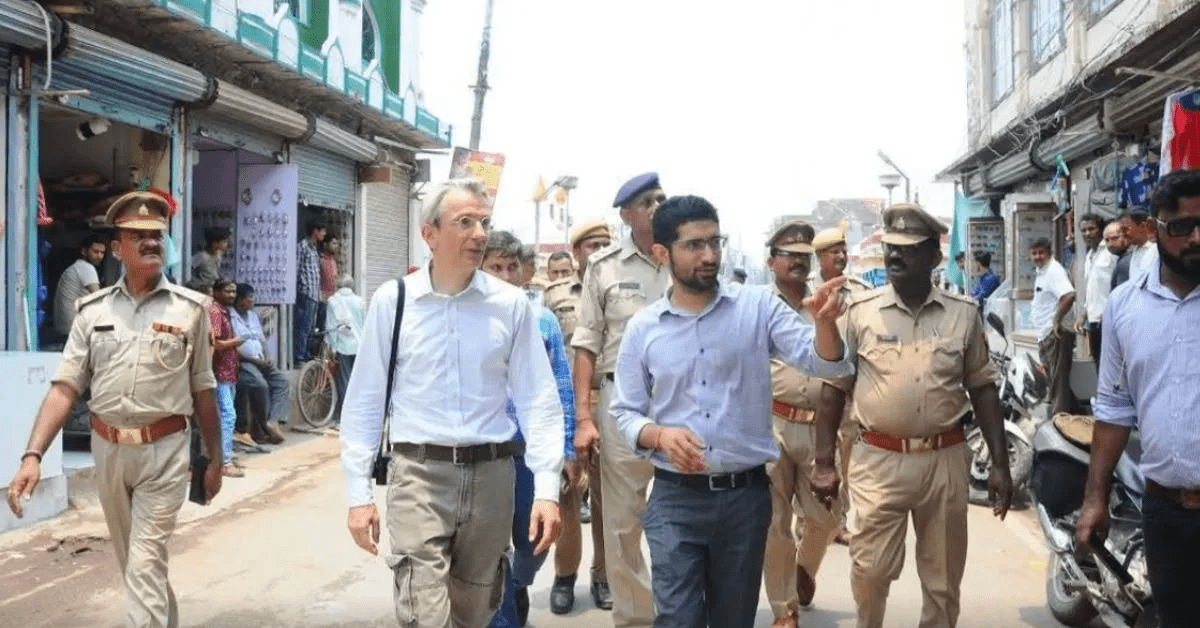
Now the holy city of Varanasi is witnessing a silent revolution beneath its soil. When IAS officer Himanshu Nagpal took charge as the Chief Development Officer (CDO), the city was grappling with a plummeting groundwater table and a growing dependency on 700 new borewells annually. Therefore, Nagpal launched an innovative water management plan that moved beyond traditional enforcement. Today, 39 villages have regained access to usable water, and over 1,000 public buildings have become vital recharge points for the city’s parched aquifers.
Also Read | Imran Khan and Bushra Bibi Sentenced to 17 Years in Jail
The Crisis: Why Varanasi’s Groundwater was Disappearing
Now the increasing load on Varanasi’s groundwater was reaching a breaking point. As demand from hotels, private companies, and expanding residential zones rose, nearly 700 new borewells were being dug every year. Therefore, the traditional handpumps used by ordinary residents began giving inconsistent supply.
First, many private entities ignored rooftop rainwater harvesting rules, citing a lack of physical space. Next, the rapid urbanization meant that most rainwater was simply running off into polluted drains. Thus, the city was losing its most precious resource precisely when it needed it most.
So the situation demanded more than just strict fines; it required a structural shift. Meanwhile, the crisis was spreading to surrounding rural areas. Therefore, the city’s growth was effectively “starving” the nearby villages of their natural water supply.
From Waste to Wealth: The Waterlogging Idea That Changed Everything
Now the turning point for the project came from an unlikely place: a waterlogged college campus. During every monsoon, the campus faced heavy flooding that was previously treated as a nuisance. Therefore, Himanshu Nagpal saw an opportunity to treat this “waste” water as a resource.
First, the team developed a plan to direct the stagnant rainwater into the ground rather than pumping it out. Next, this pilot project proved that existing infrastructure could be repurposed for recharge. Thus, the idea of “rainwater harvesting where it falls” was born.
So the success of the college campus provided the proof of concept needed to scale the project. Meanwhile, it silenced critics who claimed that harvesting systems were too difficult to implement. Therefore, the focus shifted from private enforcement to public utility.
Public Spaces as Recharge Hubs: Reimagining the Private Sector’s Role
Now Nagpal introduced a unique partnership model with the private sector. Instead of forcing companies to build small, inefficient systems on their own cramped properties, he asked them to adopt public institutions. Therefore, corporations began funding systems on the rooftops of schools, colleges, and hospitals.
First, these large public buildings offered massive catchment areas for rainwater. Next, the “planned way” of directing this water underground ensured maximum absorption. Thus, the private sector’s CSR funds were channeled into high-impact, visible public infrastructure.
So this collaborative approach reduced resistance from business owners. Meanwhile, it created a sense of community ownership over the city’s water table. Therefore, the administrative friction of the past was replaced by a shared developmental goal.
Also Read | Imran Khan and Bushra Bibi Sentenced to 17 Years in Jail
The Scale of Success: 1,000 Buildings and 393 Ponds
Now the numbers behind the project reflect its massive scale. Under the new management plan, more than 1,000 public buildings were successfully converted into groundwater recharge systems. Therefore, Varanasi now possesses a “digital net” of recharge points across its urban landscape.
First, the project focused on natural storage as well. Next, 393 ponds were constructed or restored across the city to manage water naturally. Thus, the city has created a dual system of artificial recharge and natural catchment.
So the cumulative effect of these 1,400+ points has significantly slowed the rate of depletion. Meanwhile, the ponds have also improved the local micro-climate and biodiversity. Therefore, Varanasi is becoming a model for integrated urban-rural water management.
Reverse Engineering: Turning 6,000 Handpumps into Injectors
Now perhaps the most ingenious part of the plan was the redesign of the humble handpump. Traditionally, handpumps are used solely for extraction. Therefore, Nagpal’s team decided to reverse their function during the rainy season.
First, around 6,000 handpumps were modified to act as “injectors.” Next, during heavy rains, these units help push excess surface water back into the aquifers. Thus, an existing network was transformed into a massive groundwater delivery system.
So the cost of this modification was minimal compared to building new borewells. Meanwhile, it utilized a network that reached into every corner of the city and its outskirts. Therefore, the very tools that were once blamed for depletion are now part of the solution.
River and Wetland Revival: The Scientific Approach with IIT (BHU)
Now the project was not limited to mechanical systems. Nagpal sought help from scientific institutions like IIT (BHU) and environmental organizations like the WWF. Therefore, the restoration efforts were based on local geography and hydrological data.
First, a 30 km stretch of a heavily polluted river was successfully revived. Next, wetlands were restored using scientific planning to ensure they could function as natural sponges during the monsoon. Thus, the project addressed both the quantity and the quality of water.
So the scientific input ensured that the recharge happened in the right locations to reach the deepest aquifers. Meanwhile, the revival of the river has improved the overall health of the Ganges ecosystem. Therefore, Varanasi’s traditional water bodies are breathing again.
Also Read | Imran Khan and Bushra Bibi Sentenced to 17 Years in Jail
The Rural Impact: How 39 Villages Got Their Water Back
Now the ultimate metric of success is the recovery of the surrounding countryside. As groundwater levels in the city began to stabilize, the benefits rippled outward. Therefore, 39 villages that had struggled with dry wells for years have finally regained access to usable water.
First, the “recharge net” created in the city helped replenish the common aquifers shared with the villages. Next, the construction of ponds in the periphery provided local storage for irrigation. Thus, the urban-rural divide in water security has been bridged.
So the project proves that urban water management is the key to rural survival. Meanwhile, the residents of these villages are seeing a return of their livelihoods. Therefore, Himanshu Nagpal’s water story is now a legacy of hope for the entire region.
FAQ: Varanasi’s Water Management and IAS Himanshu Nagpal
1. Who is the IAS officer behind Varanasi’s water transformation? Now, the project was led by Himanshu Nagpal, who serves as the Chief Development Officer (CDO) of Varanasi.
2. How did the team convert handpumps into recharge points? First, they redesigned 6,000 handpumps to act as injectors. Next, these pumps push rainwater back into the ground instead of just extracting it.
3. What was the role of the private sector in this plan? So instead of small systems on their own properties, companies funded rainwater harvesting on the rooftops of 1,000+ public buildings like schools and hospitals.
4. How many villages benefited from this project? Next, a total of 39 villages regained access to their water sources as the groundwater levels began to recover.
5. Which scientific institutions helped in the river revival? Now, the project saw significant support from IIT (BHU) and the WWF, focusing on wetland and river restoration.
6. What was the main philosophy of this water plan? Finally, the approach relied on the idea that rainwater should not be allowed to run off as waste but should be directed back underground using existing methods in new ways.
Also Read | Imran Khan and Bushra Bibi Sentenced to 17 Years in Jail
End…