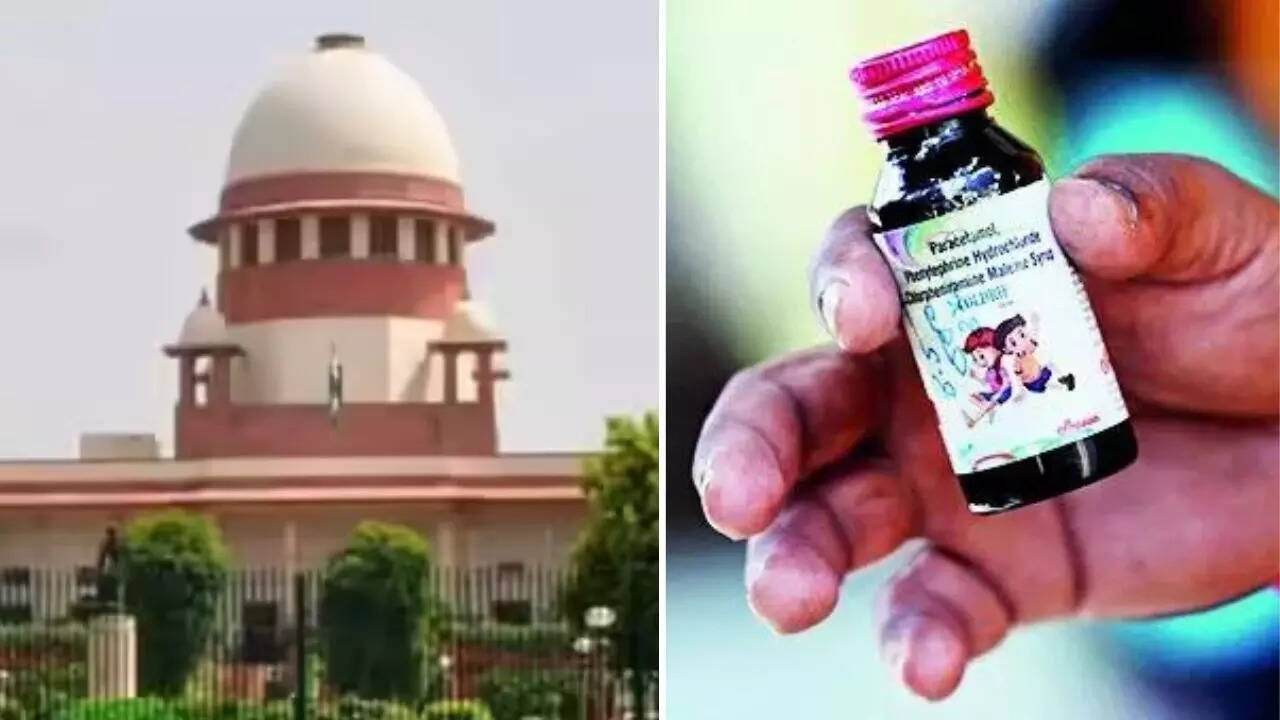
The Supreme Court of India on Thursday issued a scathing rebuke to Noida-based Marion Biotech, whose cough syrups were linked to the deaths of 18 children in Uzbekistan in 2022. Dismissing a plea by the company and its directors to quash summons, a bench led by CJI Surya Kant suggested that the officials deserved “murder charges” rather than just regulatory violations.
“You should be charged with murder too… but for the jurisdiction,” the bench observed. The court emphasized that the incident had brought a “bad name to the country” and refused to offer any “indulgence” to the firm, mandating that they appear before the trial court in Gautam Budh Nagar.
Also Read | Imran Khan and Bushra Bibi Sentenced to 17 Years in Jail
The “Murder” Remark: CJI Surya Kant’s Scrutiny
During the hearing, the bench expressed shock that appropriate provisions of the Indian Penal Code (IPC) appeared to be missing from the current prosecution. The CJI noted that the allegations were grave enough to warrant “more stringent sections.”
The court’s observation signals a possible re-evaluation of how pharmaceutical negligence is prosecuted in India. “So many children have died… We can add those provisions here if you are willing too much to press the petition,” the bench warned the company’s counsel, effectively ending the plea for relief.
Legal Backdrop: The Drugs and Cosmetics Act
The trial stems from a complaint filed by a drugs inspector under the Drugs and Cosmetics Act, 1940. The allegations include:
-
Section 34: Vicarious liability of directors for the company’s affairs.
-
Adulteration: Manufacture and sale of drugs declared “not of standard quality.”
-
Procedural Non-compliance: Violations in manufacturing protocols recorded at the Ship Building Centre in Visakhapatnam.
The Allahabad High Court had previously rejected the company’s revision petitions on January 14, 2026, holding that directors cannot escape liability by claiming they were not involved in day-to-day operations.
Also Read | Imran Khan and Bushra Bibi Sentenced to 17 Years in Jail
Toxic Formulations: Ethylene Glycol in Focus
The global alert issued by the WHO specifically flagged the presence of ethylene glycol in Marion Biotech’s Dok-1 Max and Ambronol syrups. Ethylene glycol is a toxic industrial chemical used in products like antifreeze; its presence in medicines is strictly prohibited under the British Pharmacopoeia 2020.
Authorities in Uttar Pradesh have already permanently canceled the company’s manufacturing license, while India’s health ministry suspended all production at the Noida facility.
Reality Check
The SC’s “murder” comment is a powerful rhetorical stance. Still, legally charging a pharmaceutical executive with murder ($Section 302$) requires proving intent or “knowledge” that the act would likely cause death. Therefore, while the court is pushing for more “stringent sections,” the prosecution will likely stick to Culpable Homicide Not Amounting to Murder ($Section 304$) or Negligence ($Section 304A$), which are easier to prove in regulatory failures. In fact, most pharma cases in India struggle with convictions due to complex “supply chain loops” that allow directors to shift blame to lower-level quality control officers.
Also Read | Imran Khan and Bushra Bibi Sentenced to 17 Years in Jail
The Loopholes
The directors argued they had nothing to do with day-to-day work. In fact, Section 34 of the Drugs Act is a “legal loophole-closer” specifically designed to prevent this defense. Therefore, as long as they were “in charge” at the time of manufacture, their personal involvement in the lab is irrelevant. Still, the “jurisdiction” issue mentioned by the SC—where the crime (deaths) happened in Uzbekistan but the act (manufacture) happened in India—remains a complex legal gray area for trying murder charges domestically.
What This Means for You
If you are a consumer, this ruling is a landmark for “Drug Safety Accountability.” First, understand that WHO medical alerts are now being treated as primary evidence in Indian courts. Then, expect stricter export quality checks for all Indian-made syrups; the government has already mandated that all cough syrup exports must be tested at government labs before shipping.
Finally, realize that the “Bad Name” remark by the CJI is a signal to the entire pharma industry. You should favor brands that provide Batch-level QR codes for tracking quality reports. Before using any over-the-counter (OTC) syrup, check if it has been flagged on the Central Drugs Standard Control Organization (CDSCO) “Not of Standard Quality” (NSQ) monthly lists.
What’s Next
The company directors must now appear before the Chief Judicial Magistrate (CJM) in Gautam Budh Nagar to face trial. Then, the trial court will decide whether to add more stringent IPC sections as suggested by the Supreme Court. Finally, the Indian government is expected to announce a new “Global Pharma Quality Shield” policy by late 2026 to restore international confidence in “The Pharmacy of the World.”
Also Read | Imran Khan and Bushra Bibi Sentenced to 17 Years in Jail
End….