

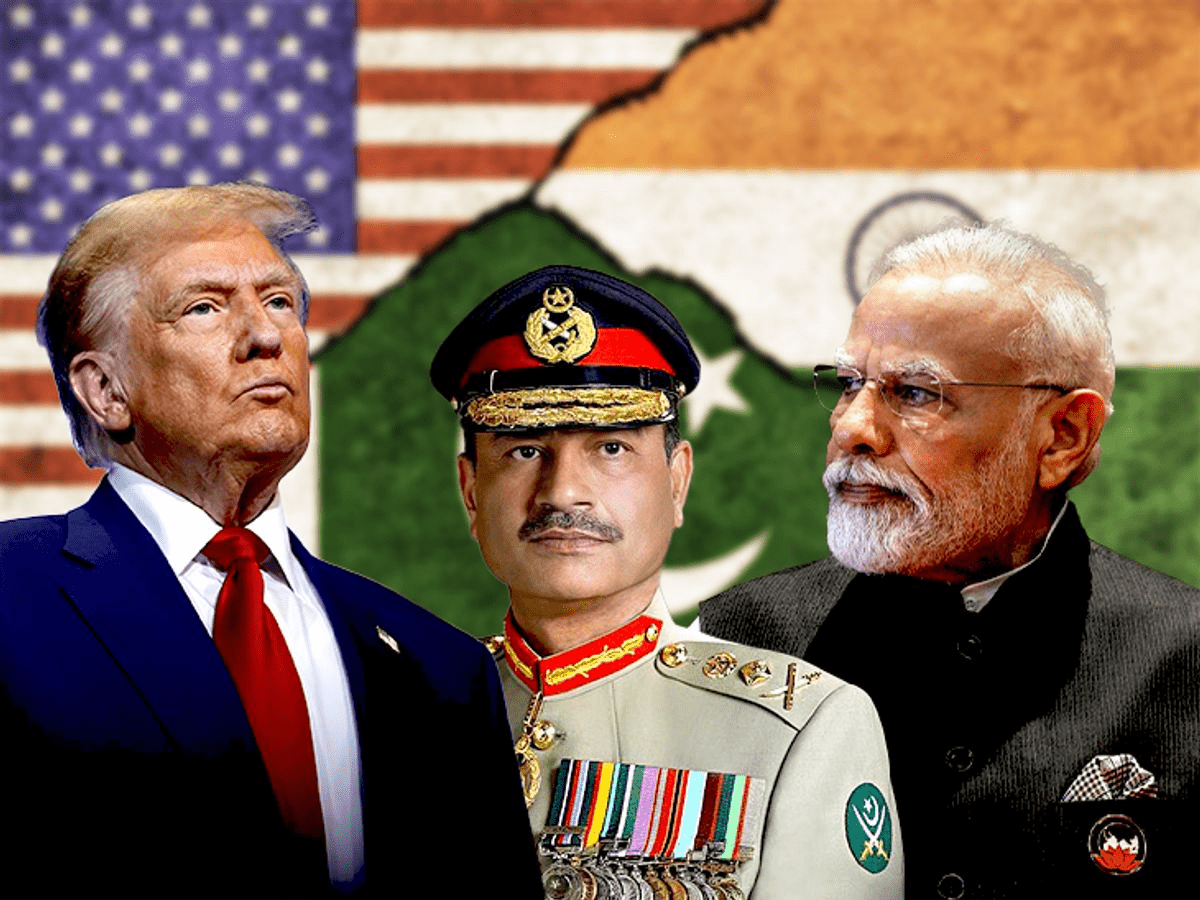
Now the White House launched a massive diplomatic repair mission Sunday evening. Officials want to patch up a widening India US relations strain immediately. Specifically, US Secretary of State Marco Rubio landed in New Delhi for critical talks. Meanwhile, President Donald Trump bypassed normal protocol with an unexpected phone call. He patched directly into an embassy reception to praise Prime Minister Narendra Modi.
Today, sweet words cannot mask deep strategic fractures. The recent US alignment with Islamabad has severely damaged bilateral trust. Therefore, Indian diplomats are offering a notably chilly reception to American envoys.
Think again if you expected a standard diplomatic honeymoon.
Also Read | Imran Khan and Bushra Bibi Sentenced to 17 Years in Jail
The Embassy Stage: Early Celebrations Explained
Now the timing of the American event raised several eyebrows. The US Embassy hosted its annual Independence Day reception on May 24. Therefore, the grand celebration occurred weeks before the actual July 4 milestone.
Officials scaled up the gathering to mark the upcoming American Semiquincentennial. That represents the 250th anniversary of the US Declaration of Independence. Still, diplomatic observers saw a clear alternative motive at play.
Washington advanced the timeline strictly to accommodate Secretary Rubio’s schedule. Thus, the embassy grounds turned into a grand damage-control stage.
A Strained Stage
First, consider the background of this sudden visit. The Trump administration spent months cultivating deep ties with Islamabad. This policy came at India’s direct expense. Therefore, a profound India US relations strain began to solidify in South Asian policy circles.
Next, look at the composition of the American delegation. Top security officials accompanied Rubio to the national capital. This heavy presence highlights the sheer urgency of their Asian pivot.
So the advanced holiday party served a real geopolitical purpose. It provided an immediate, neutral venue to de-escalate growing tensions.
The Strategic Pivot
Meanwhile, the broader regional architecture requires urgent stability. The Indian Ocean shipping lanes face constant security threats. Because of this, Washington cannot afford to isolate New Delhi for long.
Now, the administration is sprinting to reverse its previous missteps. They want to project a picture of seamless harmony. Still, the underlying cracks remain entirely visible to veteran analysts.
Public Romance Versus Grim Diplomatic Realism
Now President Trump loves using public pageantry to bypass complex policy stalemates. His latest phone patch-through followed this exact playbook. Therefore, guests at the New Delhi embassy heard his voice directly over the speakers.
The Trump Pitch
First, the US President showered lavish praise on Prime Minister Modi. “I just wanna say you are great,” Trump told the crowd. “We have never been closer to India. India can count on me 100 percent.”
Next, he bragged about domestic American achievements. He cited record stock market numbers and economic growth. Then, he offered an open-ended promise to New Delhi.
“Anything India wants, they will get,” Trump asserted during the brief call. “I am a big, big fan of Prime Minister Modi.”
So the verbal courtship was incredibly intense.
The Chilly Reality
Meanwhile, the Indian diplomatic core remained entirely unmoved by the charm offensive. They view foreign policy through the lens of cold realism. Therefore, words must match actions on the ground.
Currently, actions tell a very different story. Washington’s recent behavior has triggered a significant India US relations strain across multiple ministries.
Thus, a polite applause was the only response Trump received. Indian officials know that American priorities can shift with a single tweet. Public romance cannot fix broken security guarantees.
Jaishankar Draws the Line on Counter-Terrorism
Now India’s formal counter-message was swift and unyielding. External Affairs Minister Dr. S. Jaishankar took the podium immediately after the American presentations. Therefore, the audience witnessed a stark contrast in diplomatic tones.
The Zero Tolerance Directive
First, Jaishankar directly addressed the core issue of cross-border terrorism. He emphasized that New Delhi maintains absolute zero tolerance for state-sponsored violence. Next, he looked toward the American delegation. He noted that security cooperation requires complete clarity between partners.
So the warning was unmistakable.
India will not accept Washington supporting Pakistan at the cost of Indian lives. Specifically, Trump cannot keep Pakistani General Asim Munir on the White House speed dial while claiming to be India’s best friend.
De-Risking the Economy
Still, the Minister acknowledged areas of successful cooperation. He noted that both democracies share an interest in de-risking global supply chains. They want to provide the world with safer economic choices.
But security remains the ultimate baseline.
“We must see eye-to-eye on regional stability,” an Indian ministry source later clarified. Thus, India delivered its sharp reminder from the very heart of the US mission.
Also Read | Imran Khan and Bushra Bibi Sentenced to 17 Years in Jail
Rubio Faces Cold Protocol in New Delhi
Now Secretary Marco Rubio is experiencing a very difficult diplomatic climate. The mid-summer heat in New Delhi is famously brutal. Therefore, the political atmosphere matched the outdoor thermometers perfectly.
The Protocol Signal
First, consider the reception Rubio received at the airport. Indian authorities offered the bare-minimum protocol required for a visiting foreign secretary. No senior ministers lined the tarmac. Instead, mid-level bureaucrats processed the arrival.
Next, remember Rubio’s recent political history. He previously spent weeks praising Pakistan’s military apparatus. He frequently complimented Field Marshal Asim Munir during the height of the Gulf naval crisis.
Consequently, New Delhi chose to signal its deep displeasure through silent protocol adjustments.
The Tightrope Walk
Meanwhile, Rubio spent his official meetings attempting a delicate diplomatic balancing act. He worked hard to downplay Washington’s relationship with Islamabad.
“Our ties with Pakistan are strictly tactical,” Rubio insisted to Indian negotiators. “They will never come at the expense of our strategic alliance with India.”
Will this explanation satisfy South Block? Not quite.
India has practiced immense strategic restraint for months. They are tired of Washington placating hostile neighbors while demanding local market access.
The Racist Online Comment Controversy
Now the diplomatic tension extended into the press room. Journalists caught Secretary Rubio completely off guard during a routine media briefing. Therefore, the session quickly turned into an exercise in political damage control.
The Spark
First, reporters questioned Rubio regarding President Trump’s recent social media behavior. The US President had recently liked several derogatory online comments targeted directly at Indian citizens. Next, journalists demanded to know how such actions aligned with a “strategic partnership.”
So the room went completely silent.
The Deflection
Then, Rubio attempted to minimize the internet controversy. He framed the United States as an inherently welcoming, diverse nation.
“Every country has some ‘stupid’ people who make online comments,” Rubio remarked defensively.
Otherwise, he refused to address the President’s personal social media feed. This awkward moment further intensified the India US relations strain lingering over the entire summit.
Economic Bleeding: Visas, Tariffs, and the Quad
Now the underlying India US relations strain extends far beyond defense policy. Key friction points have steadily bled into economic and civilian sectors. Therefore, ordinary citizens are feeling the direct impact of the political chill.
The Immigration Wall
First, the Trump administration recently implemented highly restrictive H-1B visa rules. These updates deeply frustrate Indian IT professionals. Next, a disruptive new mandate forces Green Card applicants to return home for routine paperwork processing.
Thus, tech sector mobility has ground to a sudden halt.
Trade Wars and Tariffs
Meanwhile, trade negotiations remain completely stalled. Washington continues to levy stiff American tariffs on Indian steel and aluminum. In response, New Delhi maintains retaliatory duties on various agricultural imports.
Because of this economic deadlock, broader agreements are impossible. In fact, these trade fights have delayed the long-overdue Quad Summit in India.
| Friction Point | US Action | Impact on India |
| Immigration | Tightens H-1B & Green Card rules | Frustrates tech sector workers |
| Trade Tariffs | Levies taxes on steel/aluminum | Stalls wider trade agreements |
| The Quad | Delays summit scheduling | Slows Indo-Pacific integration |
Gone are the days of easy bilateral progress.
Also Read | Imran Khan and Bushra Bibi Sentenced to 17 Years in Jail
The Tissue Paper Policy: Discarding Islamabad
Now we must analyze why Trump is suddenly sprinting back to India. The shift reveals the transactional nature of modern American foreign policy. Therefore, geopolitical experts are feeling completely vindicated.
The Backchannel Asset
First, the US spent months relying heavily on Pakistan’s military chief. General Munir served as the primary backchannel for secret talks with Iran. Therefore, Trump showered Islamabad with lavish praise to keep lines open during the war.
Next, look at the current state of the conflict. The US-Iran crisis is rapidly winding down. Trump recently announced that a peace deal is “largely negotiated.”
So what does that mean for Pakistan?
The Inevitable Discard
Finally, the US no longer requires Islamabad’s urgent diplomatic heavy lifting. Thus, Washington is pivoting straight back to New Delhi. They need India’s massive navy to ensure safe commerce across the Indo-Pacific.
Ultimately, this sudden shift proves an old geopolitical truth. The United States treats Pakistan like a piece of tissue paper. They use it for short-term tactical goals and discard it immediately after.
Meanwhile, India remains the indispensable, long-term strategic anchor.
Frequently Asked Questions
Why is there an India US relations strain right now? The strain stems from the Trump administration’s recent tactical alignment with Pakistan during the US-Iran war. Additionally, tough new H-1B visa rules and unresolved trade tariffs have caused significant friction.
What did President Trump say on the phone call to Delhi? President Trump stated that he loves Prime Minister Modi and described him as a “great friend.” He claimed India can count on the US 100 percent and promised that India would get anything it wants.
How did India respond to Trump’s public praise? External Affairs Minister Dr. S. Jaishankar responded by demanding absolute zero tolerance for cross-border terrorism. India emphasized that security cooperation cannot be compromised for short-term American interests.
Is there a change in the H-1B visa policy for Indians? Yes. The current US administration has tightened H-1B visa regulations and mandated that Green Card applicants return to their home countries to process basic paperwork.
What role did Pakistan play in the recent US policy shift? The US relied on Pakistan’s Army Chief, General Asim Munir, as a diplomatic backchannel to Iran. Now that the Iran crisis is resolving, the US is reducing its focus on Pakistan.
When is the next Quad Summit scheduled? The Quad Summit in India has faced consecutive delays due to ongoing trade disputes and the broader diplomatic strain between New Delhi and Washington.
Also Read | Imran Khan and Bushra Bibi Sentenced to 17 Years in Jail
End…

