

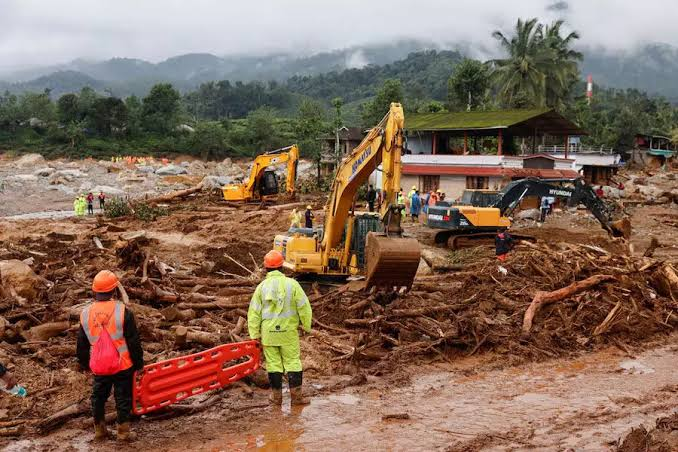
Senior ministers allege severe contractor negligence, citing a failure to clear massive mounds of excavated earth despite explicit, pre-monsoon evacuation orders from disaster management authorities.
WAYANAD, Kerala — A major debris slip occurred on Tuesday at Kalladi, near Meppadi in Wayanad district, after torrential monsoon downpours destabilized a massive mound of unscientifically stacked excavated soil. The incident took place near the entrance of the under-construction Anakkampoyil-Kalladi-Meppadi tunnel road project, a major infrastructure corridor designed to connect Kozhikode and Wayanad.
Also Read | House of the Dragon Season 3, Episode 3 Review: The Burden of the Crown Makes This the Season’s Best
While emergency search and rescue operations are actively underway near the temporary housing units built for project laborers, top state officials have explicitly rejected classifying the incident as a natural disaster. Instead, the administration has labeled the crisis an entirely preventable, man-made catastrophe stemming from a direct breach of public safety mandates.
1. Technical Distinction: Debris Slips vs. Landslides
To prevent public misinformation regarding the geographical stability of the region, geological experts and state panels emphasize the distinction between naturally occurring slope failures and industrial debris flows:
Disaster Characterization Breakdown
├── Natural Landslide ──> Gravity overcomes native rock, clay, or soil slopes; typically rain/earthquake triggered
└── Site Debris Slip  ──> Fast-moving, uncompacted excavation waste traveling rapidly downhill under intense rainfall
-
Debris Slip Mechanics: Also classified as mudflows or soil slips, these involve fast-moving, uncompacted surface materials travelling rapidly downhill with minimal warning. They are heavily aggravated when loose earth is unscientifically dumped on active mountain slopes during high-intensity rain events.
-
Natural Landslide Dynamics: These occur when tectonic shifts or structural failures cause native, deeply embedded geomaterials (such as solid rock layers, silt, and clay) to fracture and succumb to gravity.
Also Read | House of the Dragon Season 3, Episode 3 Review: The Burden of the Crown Makes This the Season’s Best
2. Why the Government Labels This “Man-Made”
Kerala Agriculture Minister T. Siddique, who is currently on-site coordinating search operations alongside the District Collector, stated unequivocally that the accident was triggered by improper waste management practices at the site.
“This is not a natural landslide. It is a man-made landslide. It happened due to the unscientific dumping of excavated earth. The government will examine why this happened and why earlier directions were not followed.”
— T. Siddique, Kerala Agriculture Minister
The Kerala State Disaster Management Authority (KSDMA) verified that the excavated debris slid downhill under the weight of 265 mm of rainfall recorded within a 24-hour window, completely blocking vital regional transit roads. Alarmingly, Minister Siddique noted that similar risky dumping patterns had been observed at the Wayanad Township project site, where housing infrastructure is being built for survivors of the devastating 2024 landslides.
3. Ignored Safety Compliance Orders
Kerala Chief Minister V.D. Satheesan clarified that the catastrophe was not born from a lapse in meteorological forecasting or delayed weather alerts. Rather, it was a compliance failure on the part of the engineering contractors.
Chronology of Warnings Ignored by Project Contractors:
Also Read | House of the Dragon Season 3, Episode 3 Review: The Burden of the Crown Makes This the Season’s Best
Chief Minister Satheesan confirmed that the local area faced roughly 225 mm of continuous rainfall during the day, which triggered the collapse of the artificial mud towers. He reiterated that the state mechanism had taken every proactive safety measure possible, and the blame lies strictly with the contractors’ refusal to execute the administrative debris clearance orders.
4. IMD Issues Severe Red Alert Protocols
The debris slip occurred amid a wider regional weather crisis across southwestern India. The India Meteorological Department (IMD) has issued a Red Alert for Wayanad, recording extreme precipitation across the Mananthavady and Vythiri zones.
Regional IMD Alert Status:
-
Red Alert Zone (Take Immediate Action): Wayanad and neighboring Kozhikode districts.
-
Orange Alert Zone (Be Prepared): Malappuram, Kannur, and Kasaragod districts.
Continuous downpours and shifting mud textures remain major challenges for rescue teams trying to verify if any laborers are trapped beneath the waterlogged earth.
Also Read | House of the Dragon Season 3, Episode 3 Review: The Burden of the Crown Makes This the Season’s Best

